https://www.youtube.com/watch?v=Y3F1v7HVYvU
MoreAmerican as a Second Language
info
A new immigrant experience, a reading about Pilgrims and Indians, that was assigned to an artist in her English language class led her to research the relationship between rituals of national glorification and enduring silence about genocide in the commemoration of Thanksgiving.
In a series American as a Second Language, Krzykawska decodes the history, national mythmaking, commemoration, and new spirituality of her new homeland, the United States.
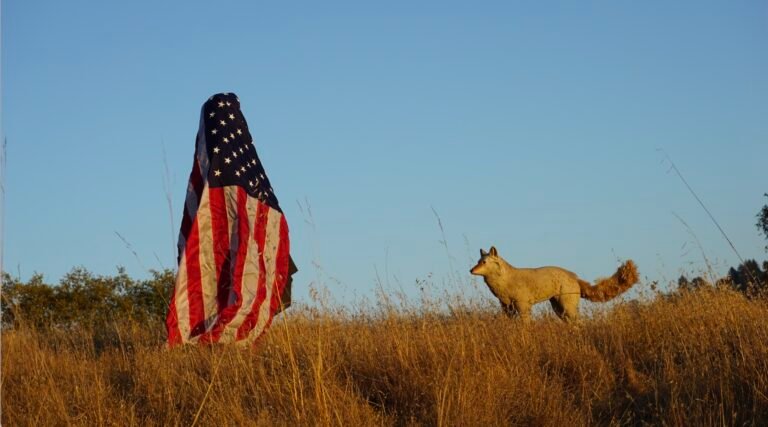
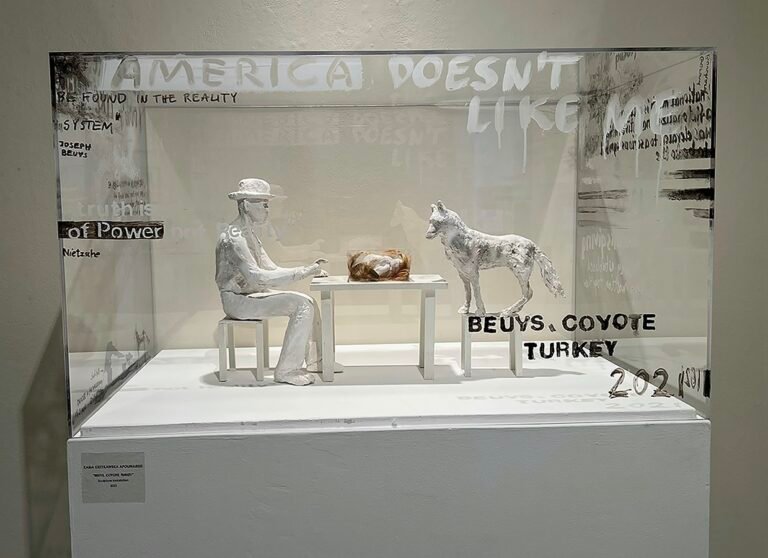
In “Beuys, Coyote, and Turkey” work Kasia Krzykawska addresses Thanksgiving’s dilemmas by alluding to Joseph Beuys’ 1974 performance I Like America, and America Likes Me, in which he locked himself in a cell with a live coyote, an indigenous animal, to “discuss” troubling American politics.
She creates a still scene with a turkey on a table, where Coyote and Beuys meet again in year 2021, that marks 400 years (according to American national myth/history) since the first Thanksgiving meal, and 100 years since the artist Joseph Beuys’ birth.
In the installation “American as a Second Language” (machinaloci, Berkeley, 2021), on two different parts of the gallery shopwindow, she quotes fragments from The 1776 Report by the President’s Trump Advisory 1776 Commission (which was released on January 18, 2021, a few days before the exhibition), and Gordan’s poetry read during the President Biden inauguration. She treats the shopfront window of machinaloci space as a sketchbook for quotes and thoughts that she gathered while adapting to a new land, new histories, and new cultural codes.
The work Stream (video, installation, 2022) is based on personal experience but is documentary in nature. The names that are present on the screen and in the flyers are those of more than sixty groupings, communities, associations, and spiritual collectives that she visited after moving to the San Francisco cultural circle. Most of them locate themselves outside mainstream religions, or in their far spectrum, and were founded in the last half of twenty century.
Beuys, Coyote, and Turkey, 2021
Window Project, installation: American as a Second Language, machinaloci, Berkeley, 2021
MorePolish Melancholies
info
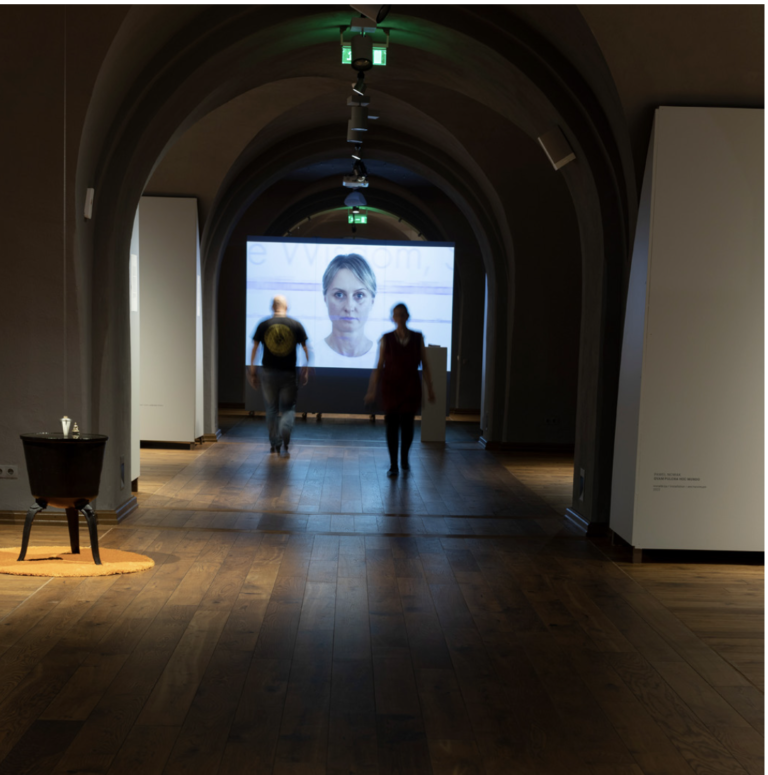
The Polish Melancholies series refers to historical traumas, symbols and national epics of my homeland.
„ Melancholy, (…) it houses the joy brought to half and is partly doomed to transform into existential sadness. (…) Melancholy is born with a particular failure, one or many of them. (…) The world of melancholy is divided into two different spaces: the upper, ideal and utopian, and lower, daily and mundane one.”
Josef Tischner, Chochol Sarmackiej melancholii [The Mulch in the Sarmatian Melancholy].
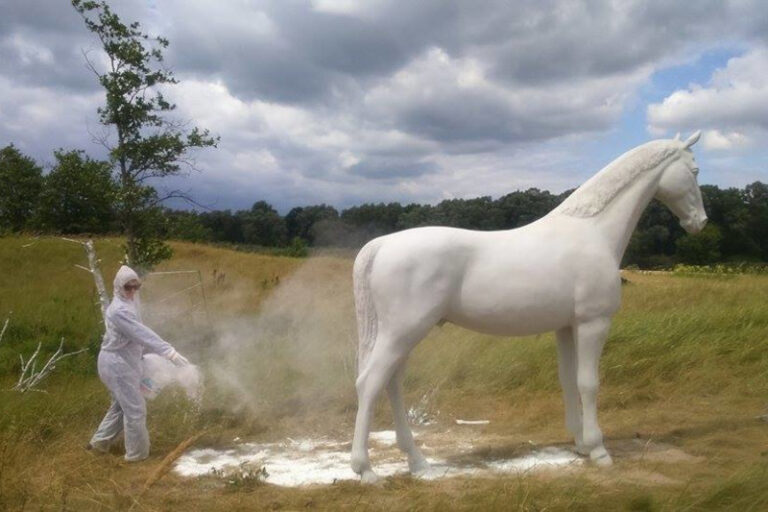
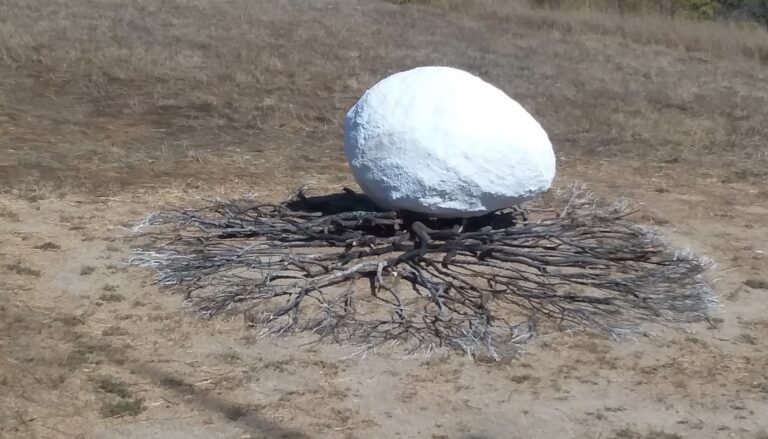
A white horse (Horse and the Polish Matter, 2015) is one of the indispensable elements of Polish artistic iconography dedicated to military successes and the fate of the country. White lime paint was used to disinfect traditional vision of patriotism and clear the field for a new context. As Kamila Leśniak wrote in “V Land Art Festival” catalogue: “Whiteness of the scenery is not the result of a simple paint, but lime used for disinfection, also corpses. This is an attempt to disenchant the myth, clear the field for the new content (…).
Borderline’s (2016) concept is based on hardly visible social classes’ battle and puts light on Polish farmer’s history. The work reflects on the nature of historically unstable idea of fraternizing peasants with the masters (“Wesele -The Wedding” by S. Wyspiański) and its contemporary issues: different visions of patriotism and service for their country. Farmers tools painted white and coated with fluorescent pigment and by night they become a surrealistic part of a theatric battle scene.
The work Swing, One Cannot Swing On (2016) denies freedom and joy associated with the act of swinging. Two swings, white and red (colors of the Polish flag) are facing each other, bumping against each other and provoking constant collisions.
Horse and the Polish Matter
V Land Art Festival, Bubel Stary, Poland, 2015.
MoreBorderline Landscape
Szczere Pole Outdoor Gallery, Kryspinów, Poland, 2016
MoreSwing, One Cannot Swing On
VI Land Art Festival, Bubel Łukowiska, Poland, 2016.
MoreAbRh+/#D4213D
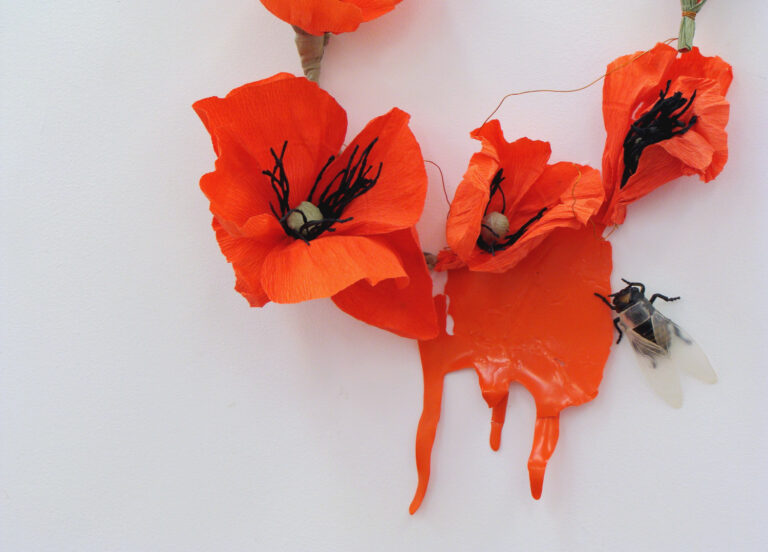
#D4213D, XX1 Gallery, Warsaw, 2011 ABRh+, XS Gallery, Fine Acrts Institute UJK, Kielce, 2010 / Dziennik Polski, 2010
MoreAbRh+/#D4213D
info
Installations ABRh+ and #D4213D (2010, 2011) research the intertwined relations between Polish countryside, patriotism and religion. #D4213D is a color code of the Polish flag redness. A red poppy flower is regarded to be a national flower of Poland. In literature the redness of poppy flowers is often symbolically associated with the shedding of blood in heroic and patriotic battles. Paper, handmade poppies appear as decoration of holly pictures in the Catholic chapels in the countryside. The flower (opium poppy) is known for its drug properties.
Natural/Unnatural
info
...
Selected outdoor works
info
...
Murmur / Spirit & Bones
Collabora’on with Sarah Bush Dance ProjectNesting, site specific at Richardson Bay Audubon Center and Sanctuary, USA, 2021 Spirit&Bones by Sarah...
MoreSelected gallery works
info
...